
Bent Hinges Pull the Whole Door Out of Alignment
Garage door hinge repair in Rome for doors moving unevenly, binding on tracks, or producing grinding noise during operation
Replacing a damaged hinge on a garage door restores more than smooth operation—it removes the lateral stress on the tracks and rollers that a misaligned panel creates every time the door runs. LCG Doors provides garage door hinge repair in Rome for homeowners dealing with doors that grind, squeak, wobble during travel, or have visible panel gaps that weren't there before. Those symptoms each indicate that one or more hinges have worn, bent, or lost the hardware needed to keep panels moving in proper relation to each other. Left unaddressed, the strain transfers to the track system and rollers, turning a straightforward hinge repair into a more involved service call.
Hinge repair begins with a full inspection across every hinge point, checking for cracked welds, bent hinge plates, worn pivot holes that have elongated over time, and loose or missing lag hardware at the mounting points. Sectional garage doors use several numbered hinge sizes—the number corresponds to the position on the door, not a universal sizing standard—so replacement parts have to match both the gauge and the position they're serving. In Midtown Rome's older residential blocks, many garage doors were installed with lighter-gauge residential hinges that are more prone to wear at the pivot point, particularly on heavier insulated replacement panels added years after original installation.
Set up a hinge inspection with LCG Doors to evaluate every connection point and identify which components need replacement before the door develops a track alignment issue..
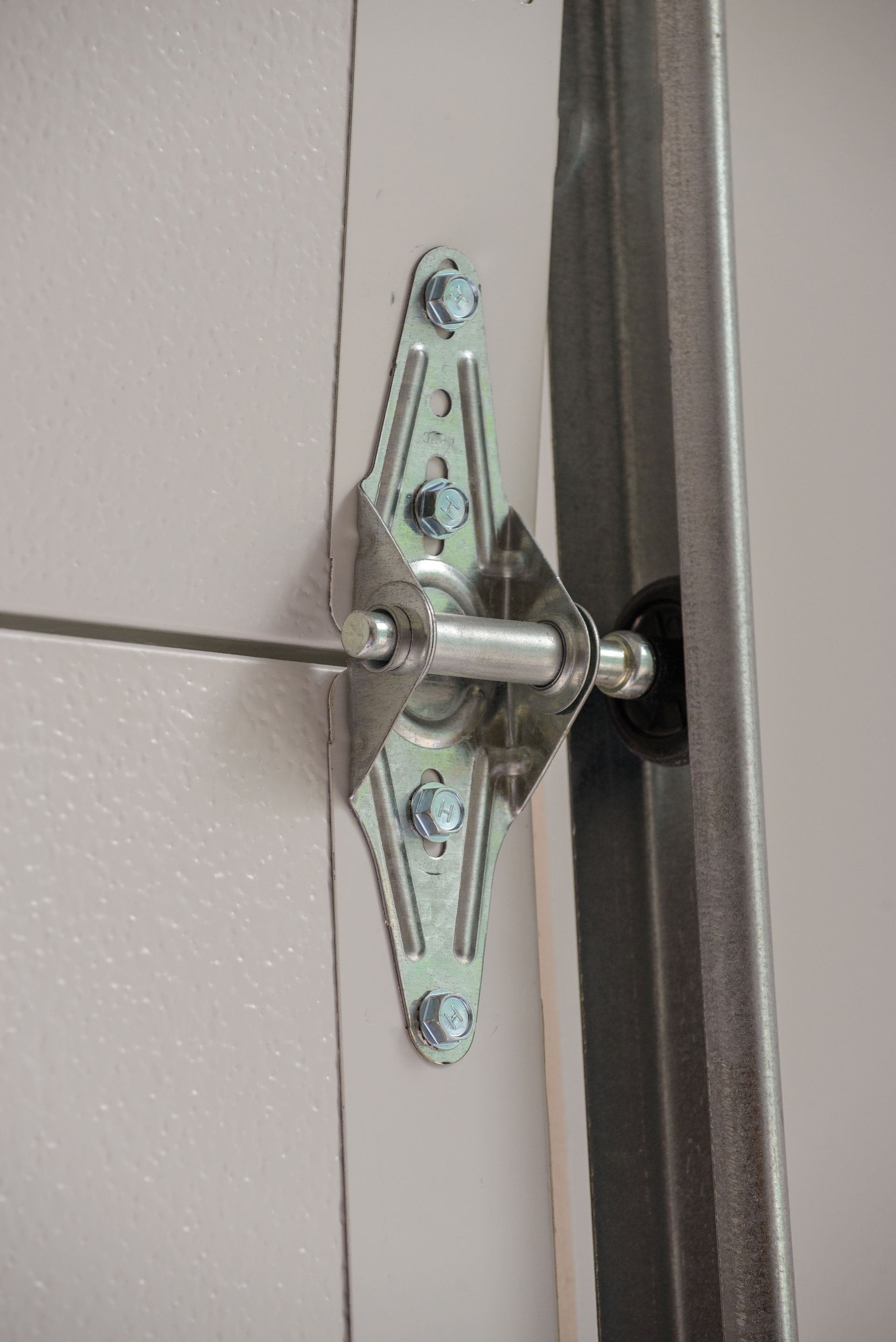
What Hinge Repair Accomplishes Beyond Stopping the Noise
Hinges connect each panel section and allow the door to articulate as it travels from vertical to horizontal along the track curve. When a hinge plate bends, the panel it connects can no longer pivot cleanly through that curve, which forces the roller attached to that hinge into an off-angle position inside the track. That roller then runs against the track wall rather than its center, producing grinding sounds and wearing both the roller and the track over time. Addressing the hinge corrects the pivot angle, which lets the roller return to its correct path without further modification to the track.
After hinge replacement is complete, the door should travel its full path without hesitation at any point in the cycle, and the noise that was present during the problem section of travel should be gone entirely. LCG Doors also verifies that the repaired hinge points aren't producing vibration that transfers to adjacent hinges, since a door that has been running with a damaged hinge for an extended period sometimes shows secondary wear at neighboring connection points.
Hinge maintenance—tightening mounting hardware and lubricating pivot points—is part of a repair visit and extends the interval before wear returns to a functional problem. Hinges that have worn their pivot holes into an oval shape from repeated lateral stress cannot be restored by lubrication alone and require replacement, because the elongated hole allows the panel to shift under load even with fresh hardware torqued down at the mounting screws..
What Owners Ask About Hinge Repair
These questions cover the inspection process, how hinge damage is identified, and what the repair involves for different door configurations common in Rome.
How do you identify which hinge is causing a noise problem when the door has ten or more hinge points?
The noise typically localizes to a specific section of the door's travel path—a grinding that appears only as the door rounds the curve at the top, for example, usually points to the top-section hinges where the most articulation stress occurs. Running the door slowly through a manual cycle while watching each hinge point makes the failing one visible before any hardware is removed.
What causes hinges to bend when nothing has physically hit the door?
Hinges bend under load stress when the door's weight is not being distributed evenly through the spring and cable system. A spring that has lost tension puts more mechanical stress on the lower hinges during the lift cycle, eventually deforming the hinge plate at the mounting holes even without a single impact event.
How are replacement hinges matched to an existing door?
Garage door hinges are numbered by position—bottom hinges, middle section hinges, and top hinges each carry different load ratings and pivot geometries. Matching the replacement to the correct position number and the door panel's gauge prevents installing a hinge rated for lighter load at a position that handles the most stress during the open cycle.
What happens to the tracks when a damaged hinge runs long enough without repair?
A hinge that forces its roller into an off-center position gradually deforms the track at that contact point, creating a worn groove or crimp that causes the roller to catch even after the hinge itself is replaced. In those cases, the affected track section has to be assessed separately to determine whether it can be straightened or requires replacement.
Why do some garage doors in Rome develop hinge problems faster than others?
Heavier insulated steel replacement panels installed on door frames originally built for lighter uninsulated panels put more load through the hinge system than it was rated to handle. This is a common configuration in Rome's established neighborhoods where original doors have been replaced but the hinge hardware and spring system weren't upgraded to match the new panel weight.
LCG Doors also performs garage door hinge repair in Calhoun, Cedartown, Cartersville, and Summerville. If your door is producing grinding or binding during operation, contact LCG Doors to arrange a full hinge and hardware inspection before the issue progresses to the track system.